


Vulnitris#
CTF: Srdnlen CTF 2025 Finals
Category: pwn
Difficulty: medium-hard
Authors: @church (Matteo Chiesa) & @davezero (Davide Maiorca)
Description#
On PlayStation the blocks descend,
In crooked towers they twist and bend.
I play and play, the rules won’t bend-
Tell me, Tetris, where’s the end?
Overview#
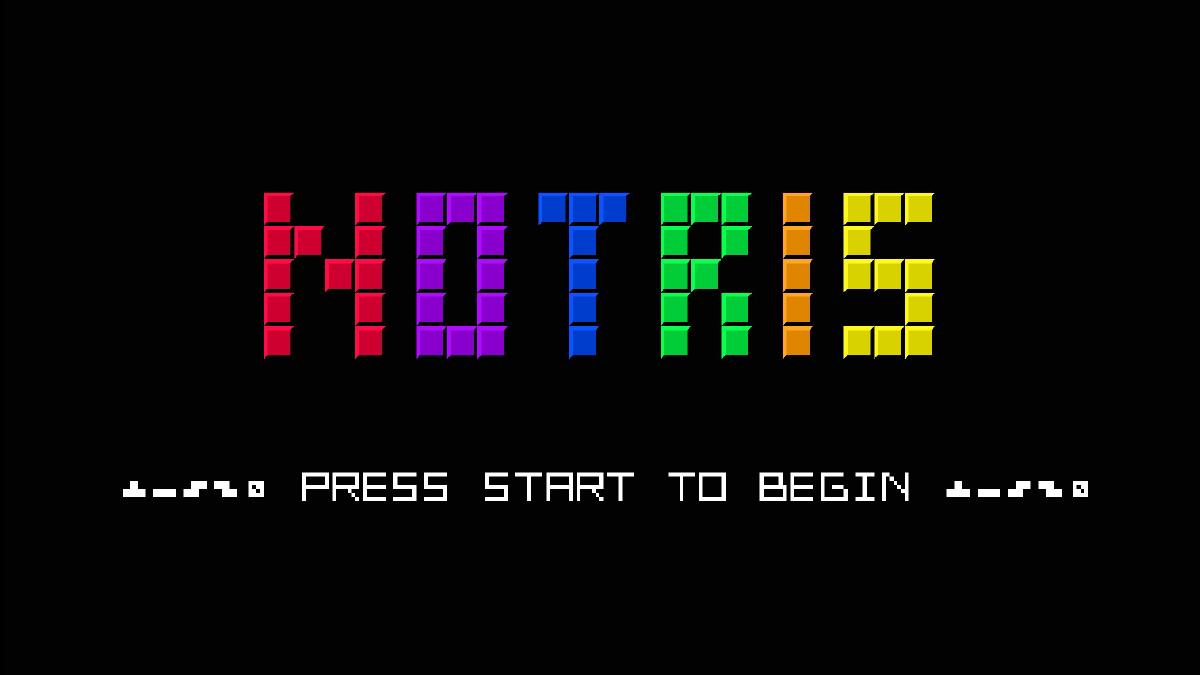
The challenge is composed by a PSX executable file, containing a custom game similar to Tetris, called Nortis. This is the same game executed in the actual PS1 on-site, the only difference is the non-redacted flag. Playing with the on-site PS1, you have to interact with the game using only the joypad, and since this is a pwn challenge, the goal must be to alter the execution flow for profit.
The PSX uses a MIPS-le architecture, so we can open this executable with a disassembler/decompiler without too much effort.
To play and debug that ROM, we are going to use no$psx, a PSX emulator and debugger.
Solution#
Discover the win function#
Looking at the strings, we can notice a redacted flag. Using no$psx, we can jump to the function at 0x80010CCC, where there is a reference to the redacted flag, and discover that function prints the redacted flag. This is the win function, but it’s never called during the normal execution flow.
Reverse the binary#
Exploring the binary, we can easily recognize the function at 0x80010000 as the main() function, and in it there is the function at 0x800110E8, which is the get_input() function, due to its structure with the AND operator, to check if a certain key is pressed.
Defining the various cases for each key, we can notice that for some imput, before calling the function relative for that action, it also increases by 1 a certain byte. In particular, it increases the byte at 0x80016144 in case of a lateral movement (left or right), and it increases the byte at 0x80016145 in case of an hard drop (when you slam down the active piece to the bottom).
These two bytes are immediatly after an array of five integers, at 0x80016130, and following the xref, we can notice it is xored in the stack by the function at 0x80010528. The length of the buffer is determined by the integer at 0x80016938.
Setting a breakpoint on 0x80010528, we can notice this function is called during the clearance of any line, and normally the length of the array is set to 0. From the stack, we can notice the distance between the array and the nearest return address is 6 integers, so if the length is 6 or more the int at 0x80016144, which is partially controlled by us moving the active piece, is xored with the return address.
Discover the vulnerability#
PLaying at the game, maybe we can notice a strange behavior: when we rotate the active piece, sometimes it clips into the other pieces or the wall. Exploring the movement function (the ones called in the main switch), we discover that in all of them the return value of the 0x80010BA0 function is checked, except in the rotate function. That is the function that checks for collisions. During the rotation there isn’t the check, so the piece can clip into other elements.
This leads to a buffer overflow: we can override something over the buffer of the game pieces field, putting a portion of a piece over the right wall, and dropping it to the bottom. The portion of that piece will write the integer after the end of the buffer field.
That exactly location corresponds to 0x80016938, where there is the integer that determines how much of the previous array will be copied in the stack!
Build the exploit#
If we can write in 0x80016938 a number >=6, we can trigger the stack overflow and override the return address.
Watching the values of that integers, the number that is written depends on the type of the piece: we can write a number >=6 only triggering the collision bug with the T piece or the Z piece.
Now we need to understand which values has to be in 0x80016144 and 0x80016145 bytes. The original return address we can override has the value 0x800106D0. The two bytes controlled by us will be xored with the less-significant bytes of that address, and we want this address to be 0x80010CCC. We can calculate the two bytes must be 0xD0 ^ 0xCC = 0x1c = 28 and 0x06 ^ 0x0C = 0x0A = 10. This means that we want to trigger the stack overflow (so we want to clear a line) after 28 lateral movements and 10 hard drops.
The last step is playing the game! You will need a couple of tries and you are done.
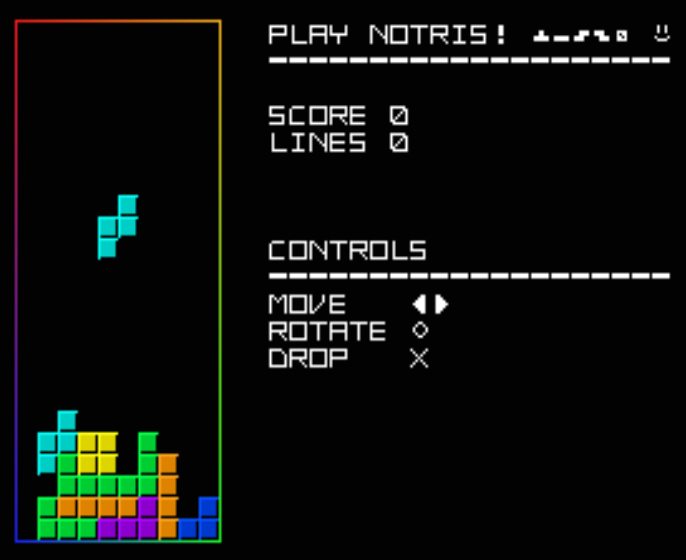
Some suggestions to trigger successfully the exploit:
- Act as you are playing regular Tetris: fit the pieces in the best way possible, and it will be much simpler to clear the line wheneven is the moment.
- Play with a friend: you have to keep two different counts, for the moves and the drops. You can count the moves until 28, while your friend can keep the hard drop count and alert you when you reached 10.
- For a move to count, doesn’t need the piece actually moving, you can press the left key and increase your count by one even if the piece is blocked by a wall.
srdnlen{1S_7H4T_7H3_F1N1SH_0F_T3TR1S?}